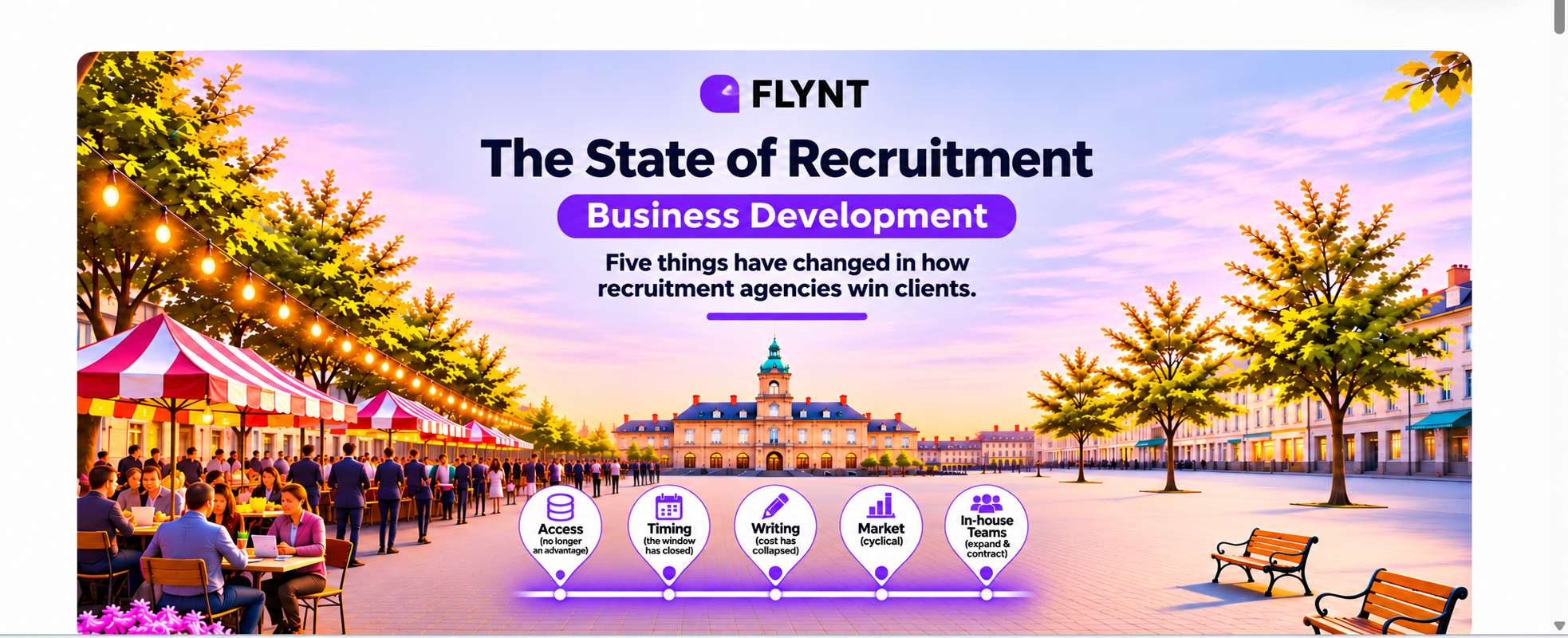
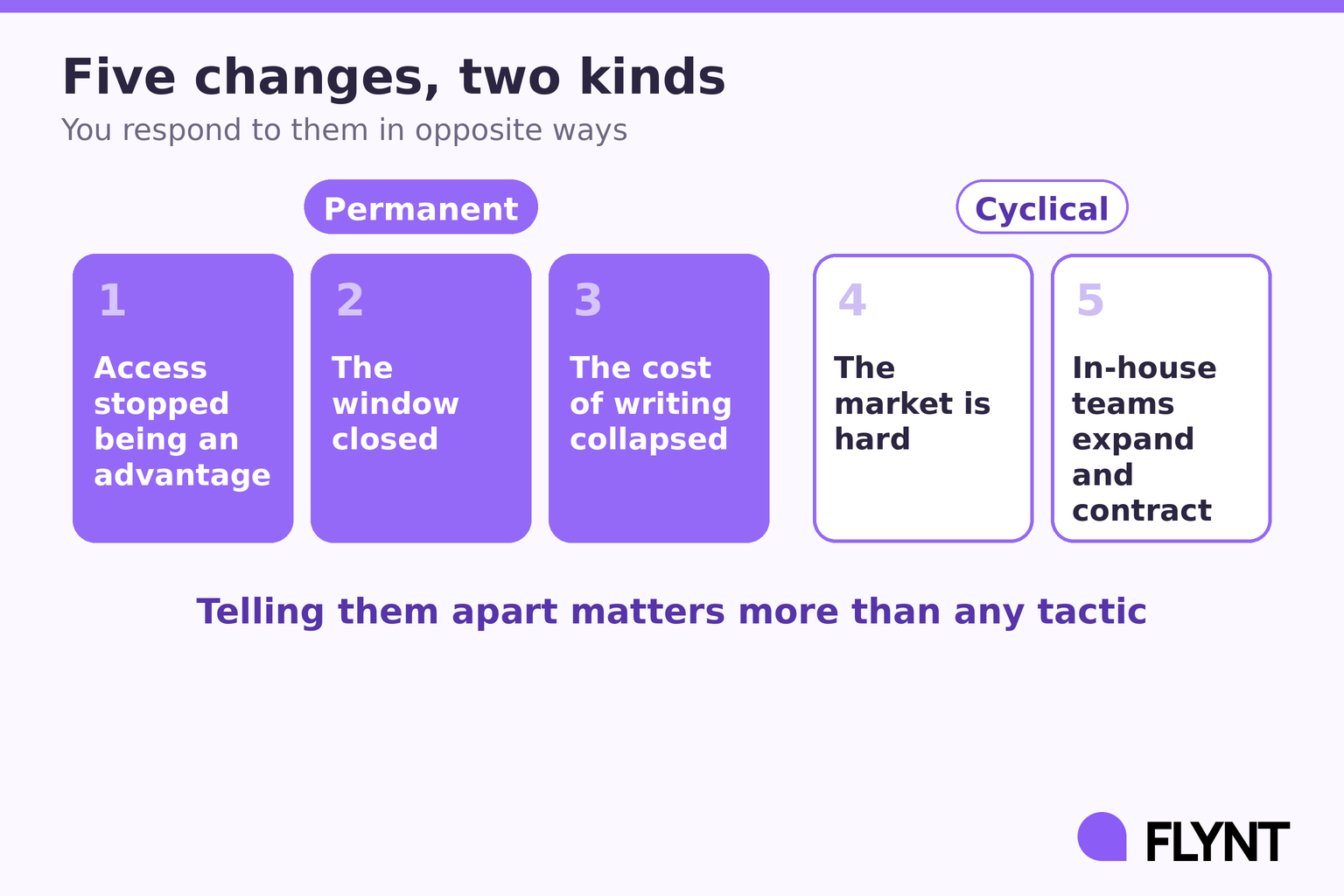
Five things have changed in how recruitment agencies win clients. Three of them are permanent and two are cyclical, and telling the difference matters more than any individual tactic, because you respond to the two categories in opposite ways.
Permanent: access stopped being an advantage
For twenty years, knowing who to call was worth something. You built a list over a decade, or you bought one nobody else had, and that list was a genuine asset that compounded.
Contact data is now cheap, abundant and substantially identical across providers. Your competitor's export is your export. The hiring manager whose details you just found has had them found by dozens of people this quarter, including every software vendor selling into their function.
This is not reversible. There is no version of the next five years in which access becomes scarce again.
What it means practically is that any strategy whose core advantage is a list has no advantage, and the agencies still buying bigger lists are solving a problem that was solved a decade ago. It also explains a pattern that looks like a copywriting failure and is not: reply rates on bought lists decline without anything changing, because the list was never exclusive and gets more crowded every quarter.
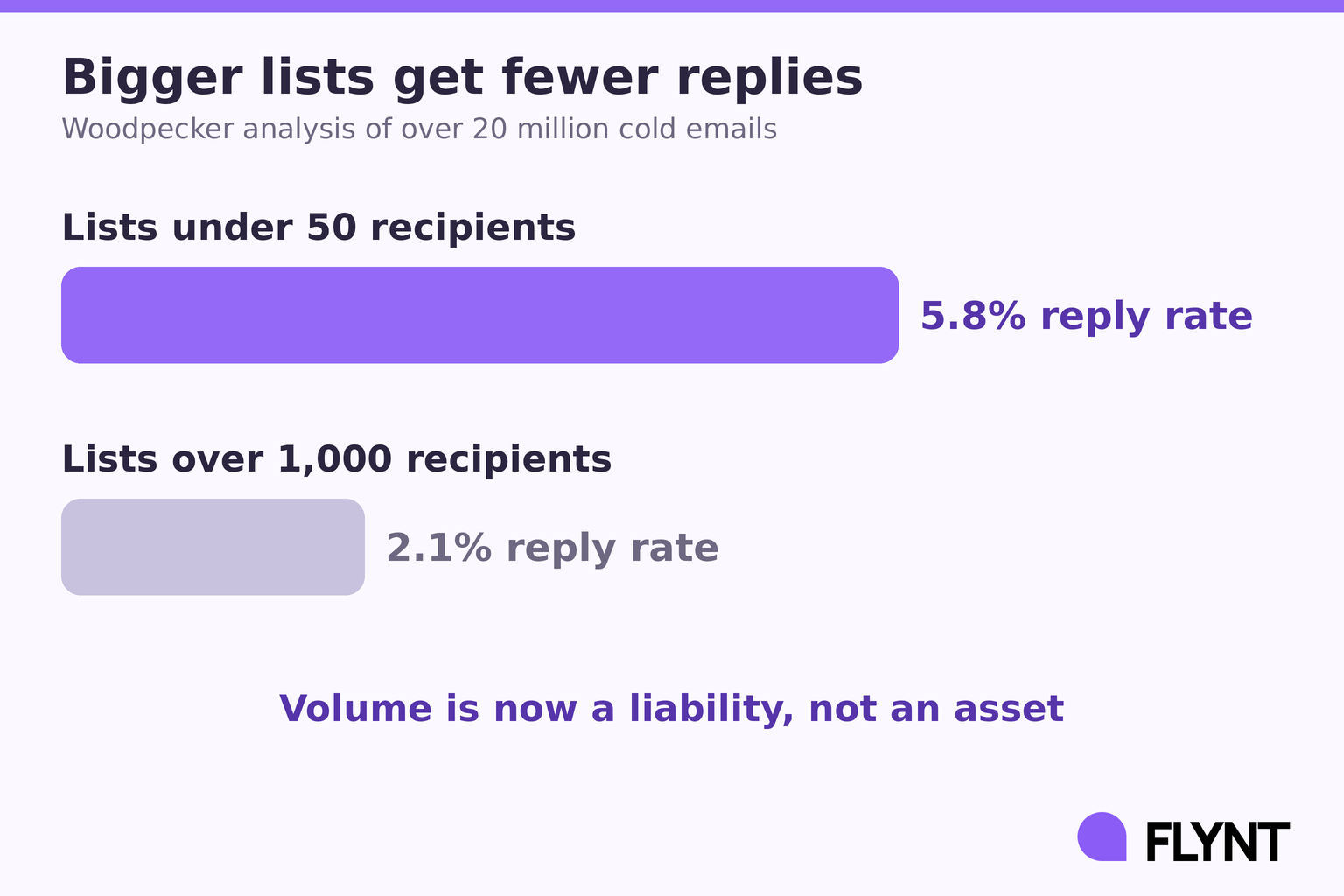
The data makes the scale of this visible. In Woodpecker's analysis of over 20 million cold emails, lists under 50 recipients averaged a 5.8% reply rate against 2.1% for lists over 1,000. Volume is now a liability rather than an asset, which is the clearest sign that access has inverted.
Permanent: the window closed
A posted role used to be workable for weeks. It is now worked by every agency in the market within days, because everyone has the same job board aggregators and the same alerts.
The half-life is short and worth knowing exactly. Days one to two, the hiring manager is motivated and almost nobody has reached out. Days three to seven, the first wave lands and filtering starts. Weeks two to three, the role sits with three agencies and your email is the fourteenth. Week four, they have stopped reading.
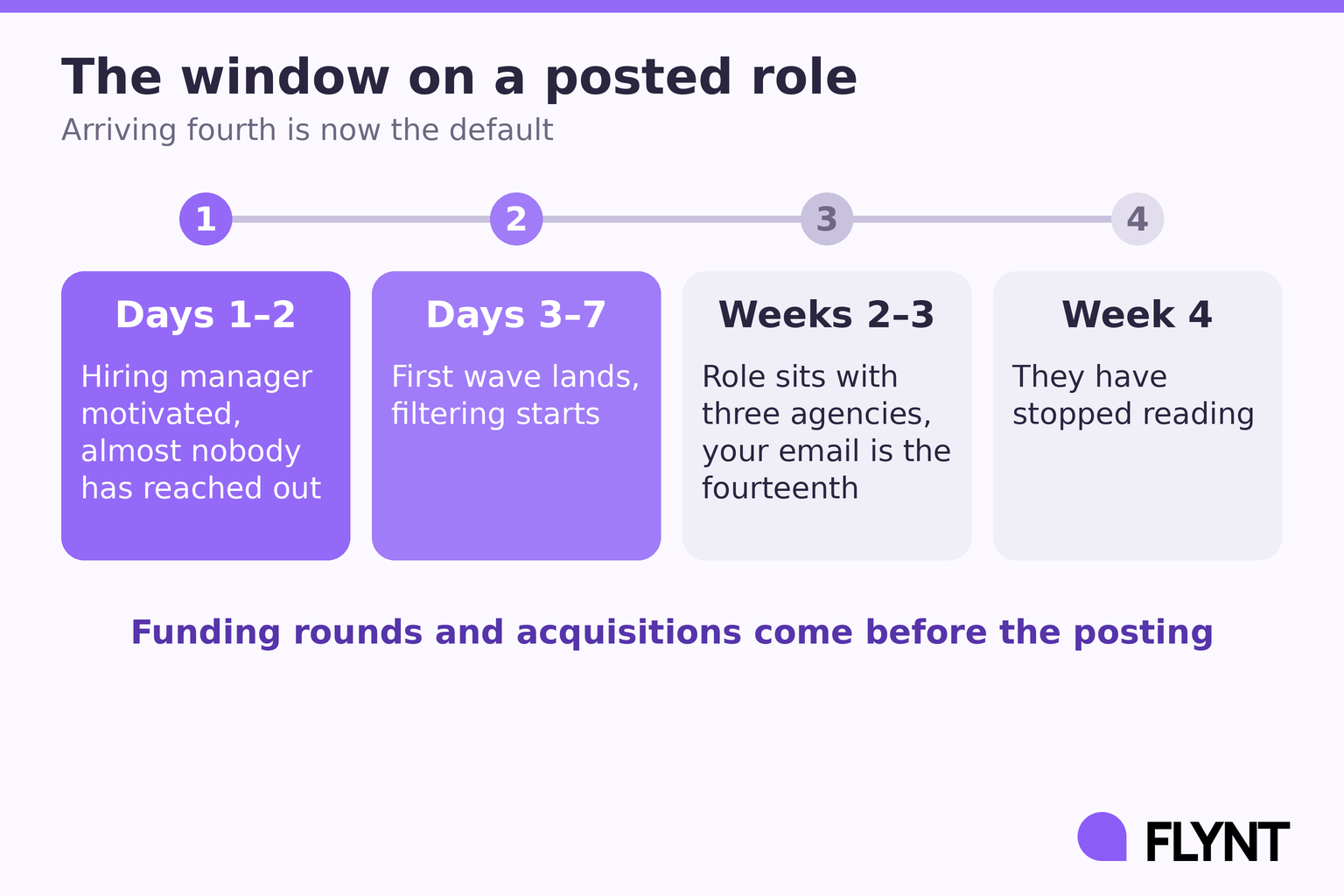
The practical consequence is that arriving fourth is now the default rather than the exception. Nothing you write out-competes a three-week delay. Relevance is mostly a timing problem wearing a copywriting costume, and most of the money spent on better messaging is spent on the costume.
This is why pre-posting signals matter more every year. A closed funding round or a completed acquisition puts you in a conversation before the posting exists, which is the only reliable way left to not be fourth.
The volume is there if you look. Staffing sector M&A alone ran to 93 transactions in 2024, with Q1 2025 up approximately 25% year on year against a 2022 peak of 139. That is one sector. Every client sector is consolidating on its own schedule, and none of it appears in a contact database.
Permanent: the cost of writing collapsed
A decent, specific, evidence-based message used to cost twenty minutes of a recruiter's time: three to read the posting, five to work out the angle, five to find the right person, seven to write.
That was the real constraint on personalised outreach, and it is why everyone used templates. Everybody knew specific was better and almost nobody could afford it forty times a week.
That cost is now close to zero for anyone using the technology properly. Which means personalisation has stopped being a differentiator and become a baseline. A generic message now stands out for the wrong reason, because the recipient is receiving specific ones from other people.
The agencies that have not adjusted are competing on a quality bar that moved while they were busy, and they experience it as the market getting harder rather than as the standard rising.
Cyclical: the market is hard, and it was hard before
Hiring slows and recovers. It has done so repeatedly and it will again. Treating a cyclical downturn as a permanent change is how agencies make the one decision that costs them the recovery.
What is worth knowing is what happens inside a freeze. Freezes are never universal. Inside any frozen sector there are companies that just raised, just won a contract, or are backfilling something critical. That list is smaller and reachable precisely because everyone else stopped looking.
The content has to change too. An email asking about open roles during a freeze gets a no that closes the conversation. An email containing salary data, or what you are seeing in their market, gets answered, because that information has more value during uncertainty than at any other time.
Freezes also end faster than anyone expects, and they end for whoever was already there. During a freeze you are not trying to close. You are trying to be the name they call when budget returns, which is a cheaper objective to achieve while nobody else is competing for attention.
The one thing that must not move is your fee. A freeze is a demand problem, not a price problem, and the rate you set in the quiet is the rate you carry into the recovery.
Cyclical: in-house teams expand and contract
Internal talent functions grow in good markets and shrink in bad ones, and agencies lose or gain roles accordingly.
The short version is that in-house teams are good at volume and process and structurally weak at scarce senior hires, confidential searches and anything urgent. That weakness is permanent even when the teams are large, which means the cyclical part is how much work they take rather than whether the gap exists.
The agencies that pick up work when internal teams contract are the ones who were already in the conversation, which is an argument for maintaining outreach into companies with strong internal teams even when they tell you they do not use agencies. That answer has a shelf life.
What this adds up to
The agencies doing well are not working harder. They have moved the point at which they enter a conversation.
Entering at the job posting means competing on speed and price against everyone with the same alerts. Entering at the funding round, the acquisition, or with a specific candidate nobody else has, means competing against almost nobody.
That is the whole shift. Everything else is implementation.
What to do about it
Stop buying access and start buying timing. The budget you spend on a larger database is better spent on knowing what happened yesterday in a smaller market.
Narrow the market until you can watch all of it. A market you can watch produces a weekly queue. A market you cannot produces an inventory.
Make outreach survive your busy months, because the compounding only works if nothing stops. An agency running sixteen productive weeks a year and one running forty-six are not in the same business, and the difference came from continuity rather than effort.
Frequently Asked Questions
Is cold outreach still working in recruitment?
Yes, and worse than it did for generic messages, better than it did for specific ones. The spread between those two has widened, which rewards anyone doing it properly and punishes anyone sending templates.
How has recruitment business development changed?
Access to contact data stopped being an advantage, the window on a posted role shrank to days, and the cost of writing a personalised message collapsed. All three are permanent.
Are recruitment agencies still viable?
The ones competing on access to candidates and companies are under pressure. The ones competing on judgement, relationships and timing are not, because none of those got cheaper.
What should an agency do in a slow market?
Keep outreach running, shift the content from asking about roles to sharing market information, target the companies still moving inside a frozen sector, and do not discount.
Does a bigger prospect list still help?
The data says no. Lists over 1,000 reply at roughly a third the rate of lists under 50, because bigger lists are less targeted and never get fully worked.
See what is moving in your market right now. Free trial at tryflynt.ai.