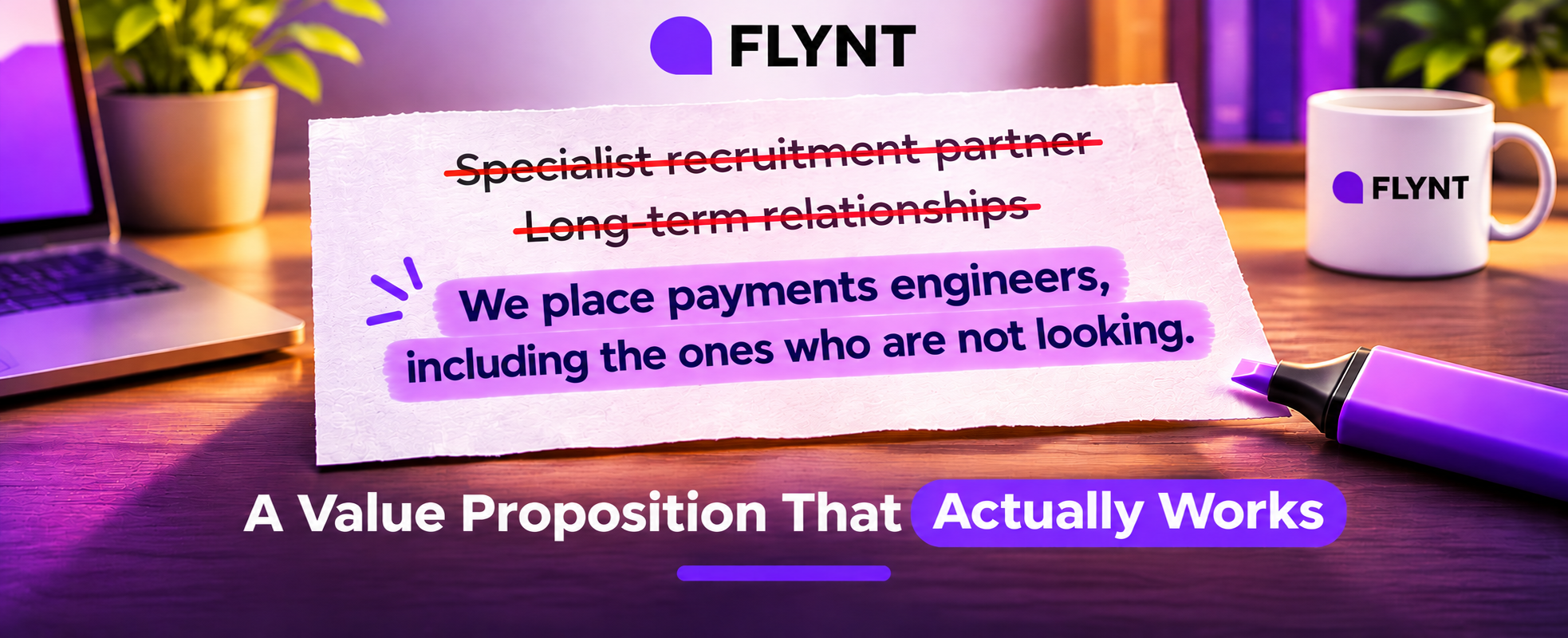
Here is a test for your recruitment agency value proposition. Take your current description, remove the name, and show it to someone in your market. Could it belong to any of your competitors? For most agencies the answer is yes, and that is the whole problem.
Why most recruiter positioning says nothing
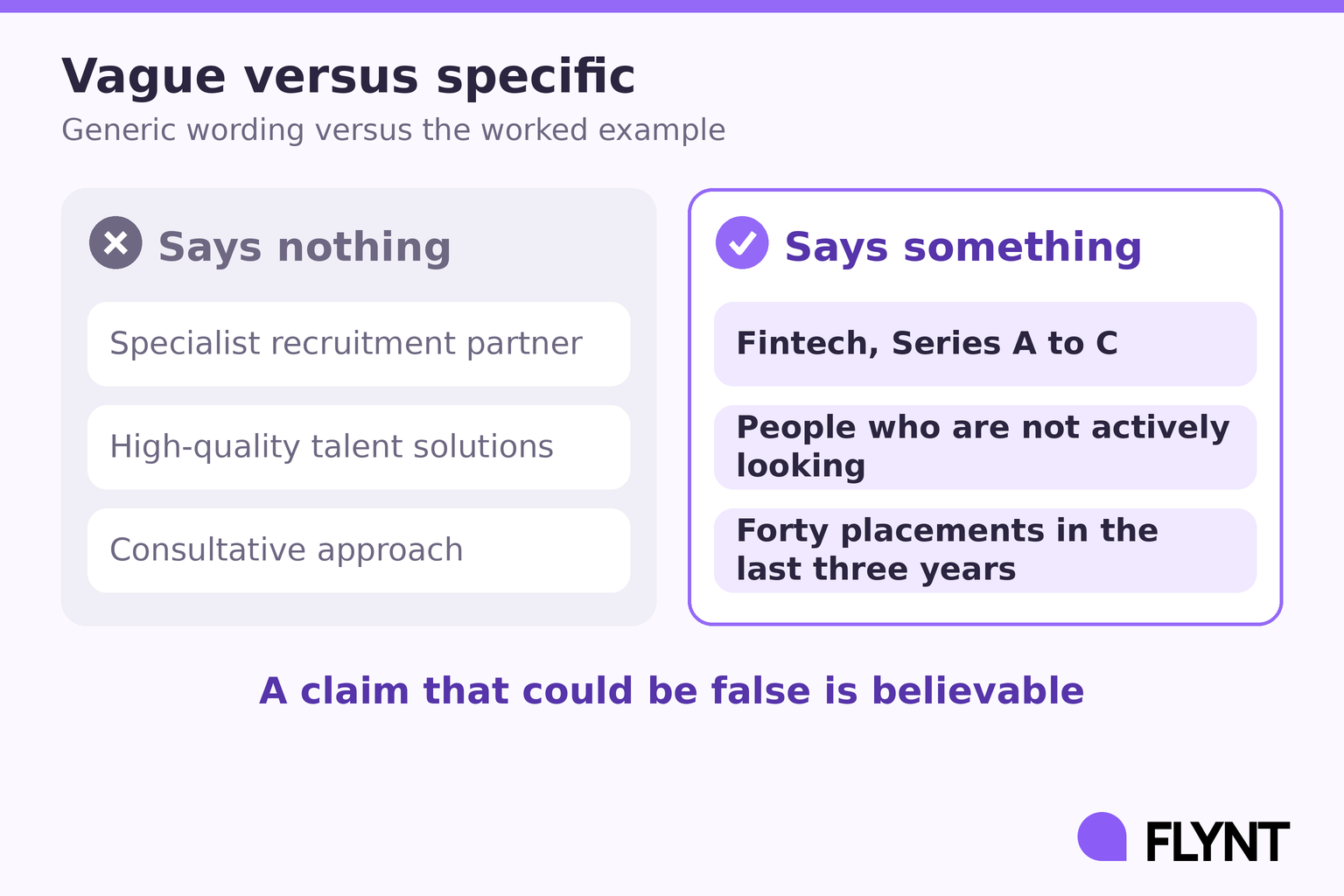
The standard version goes something like: we are a specialist recruitment partner delivering high-quality talent solutions, with a consultative approach and a commitment to long-term relationships. Every word is positive. None of it is information. A client cannot repeat it, cannot compare it, and will not remember it an hour later.
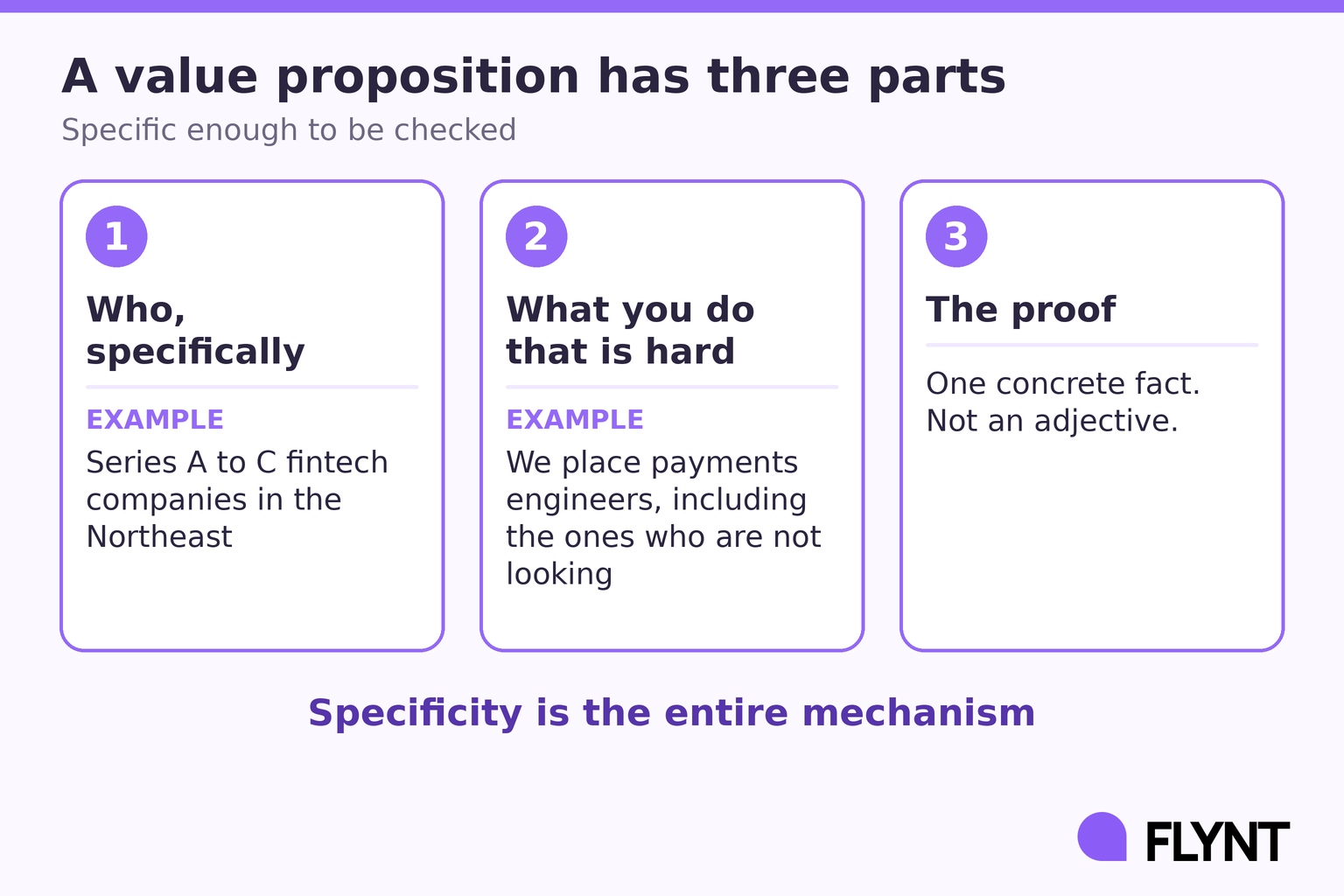
The three parts of a value proposition that works
Who, specifically
Not "technology companies" but "Series A to C fintech companies in the Northeast". The narrower this is, the more the next part is believed.
What you do that is hard
The specific thing, not the category. "We place payments engineers, including the ones who are not looking." A client should be able to picture the difficulty.
The proof
One concrete fact. The number of placements in that exact niche, the time it typically takes you, a named outcome. Not an adjective.
A worked example
"We place backend and platform engineers at fintech companies between Series A and C. Mostly people who are not actively looking, which is why we are usually filling roles that have been open for two months. Forty placements in the last three years, all in payments infrastructure."
That version is memorable because it is specific enough to be checked. Specificity is the entire mechanism: a claim that could be false is believable, and a claim that could not possibly be false carries no information at all.
Two ways recruiters get this wrong
The first is leading with your process, which interests you and no client. The second is listing values, which every agency shares and nobody chooses on.
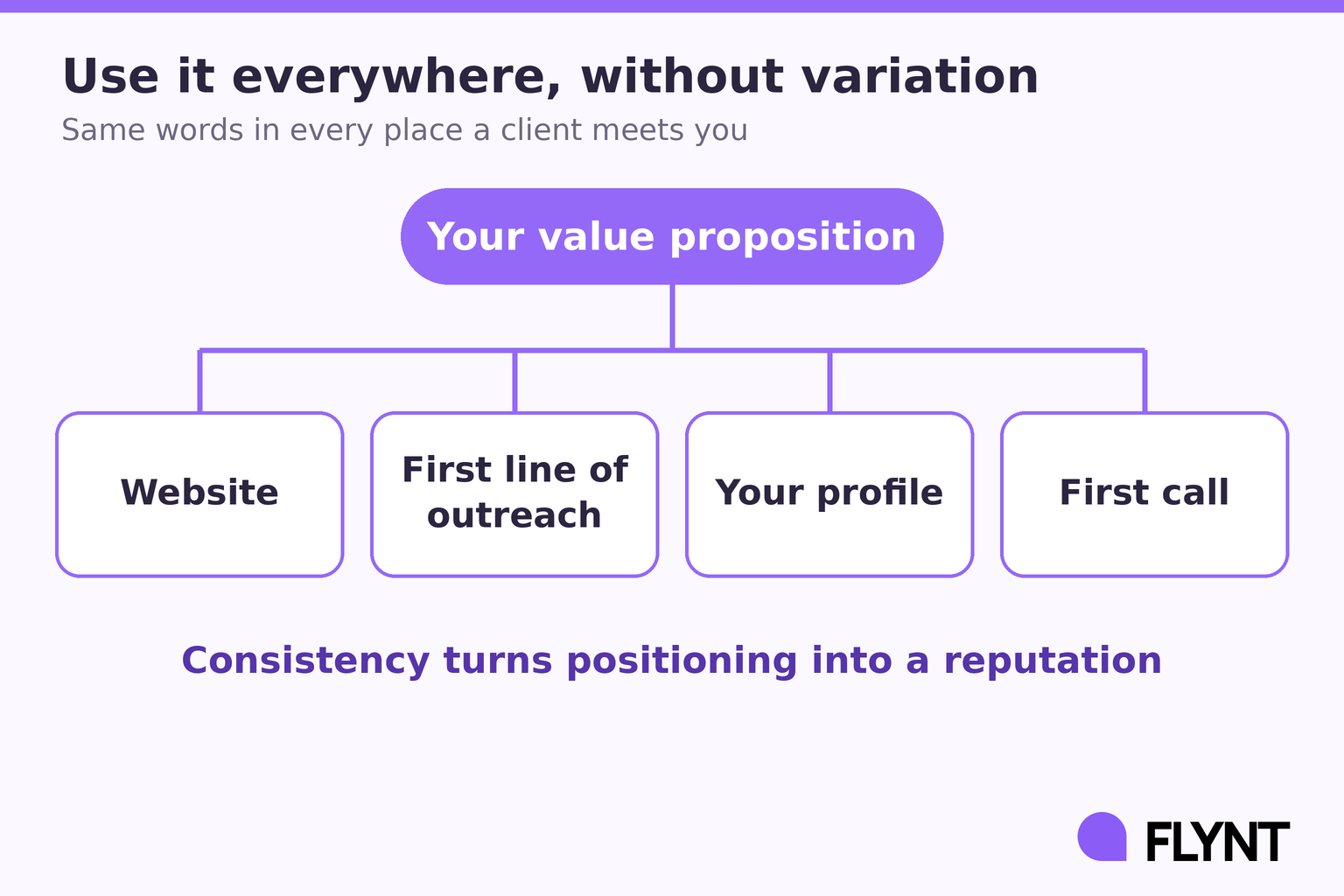
Where to use it
Everywhere, without variation: the website, the first line of your outreach, your profile, and the sentence you say on a first call. Consistency is what turns a positioning statement into a reputation.
Frequently Asked Questions
How long should a recruitment agency value proposition be?
Two sentences. If it takes a paragraph, it is a description rather than a proposition, and nobody will repeat it.
Should I mention my fees in my positioning?
No. Positioning establishes why you are worth talking to. Introducing price before value makes the conversation about cost.
What if I do not have proof yet?
Use the most specific true thing you have, even if it is small. "Eleven placements in this niche this year" is more persuasive than "extensive experience".
A sharp value proposition is wasted if it only reaches companies who already know you. Flynt puts your message in front of the companies in your niche that are hiring right now, on email and LinkedIn. See how at tryflynt.ai.