
Most advice on winning recruitment clients is a list of tactics. Tactics are the easy part. What stops agencies is that business development is the only activity in a recruiter's week with no deadline attached to it. A candidate interview has a time. A client call has a time. An offer has a deadline. Business development has none, which means it loses every single time something else needs attention, and something always does.
So the playbook below is built around that problem rather than around clever openers.
Step one: work out how few clients you actually need
Most recruiters chase volume because they have never done the arithmetic.
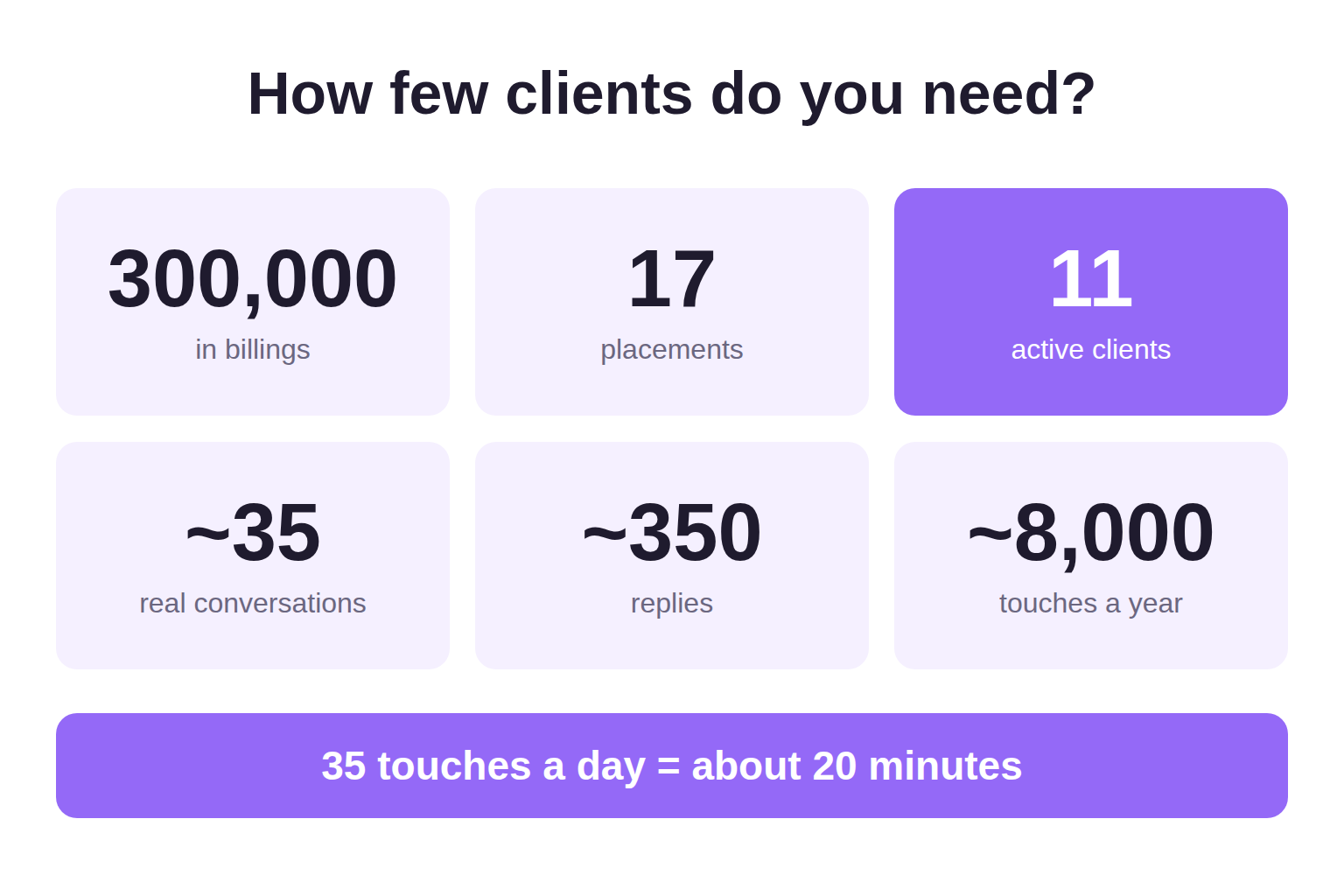
Say you want 300,000 in billings. At an average fee of 18,000, that is seventeen placements. Most agencies make two to three placements per client in a good year, so that is seven or eight active clients. Add the ones who go quiet, hire internally or restructure, and call it eleven.
Eleven companies. That is the year.
Now work backwards, using pessimistic numbers. Eleven clients needs roughly thirty-five real conversations, because most first calls do not become a live role. Thirty-five conversations needs roughly 350 replies, because most replies are not yet rather than yes. At a three to five percent reply rate, 350 replies needs around 8,000 touches across a year. Spread over 46 working weeks, that is about 175 touches a week, or thirty-five a day across email and LinkedIn combined.
Thirty-five a day is twenty minutes, if the finding and the writing already happened. The number was never the obstacle.
Run this with your own fee and your own placement rate before anything else in this article. The figure is almost always smaller than the anxiety suggests, and knowing it changes how you spend the rest of the year.
Step two: choose a market narrow enough to watch
A niche has to pass four tests, and most accidental niches fail at least one.
Volume: are there enough roles in a normal quarter, not a boom? Forty open roles nationally will not support an agency however much you enjoy the work.
Scarcity: are the people genuinely hard to find? If a company can fill the role from its own advert, your fee has nothing to attach to.
Fee size: multiply a realistic placement count by a realistic fee before committing to anything.
Repeatability: will a client who hires once hire again? Markets where companies build teams compound. Markets where they fill one senior seat every three years do not.
Technology is not a niche. It is a sector containing hundreds of them. The narrower you go, the more obviously you are the right call, and the less you compete on price.
The practical benefit is that once you have chosen, you finally know which companies to watch. Before that, every week starts with the same unanswerable question about who to contact, and that question is where most business development time actually goes.
Step three: work the three events, not just the one
Most recruitment business development waits for a job to be posted. That is one reason out of three to contact a company, and it is the last one to appear.
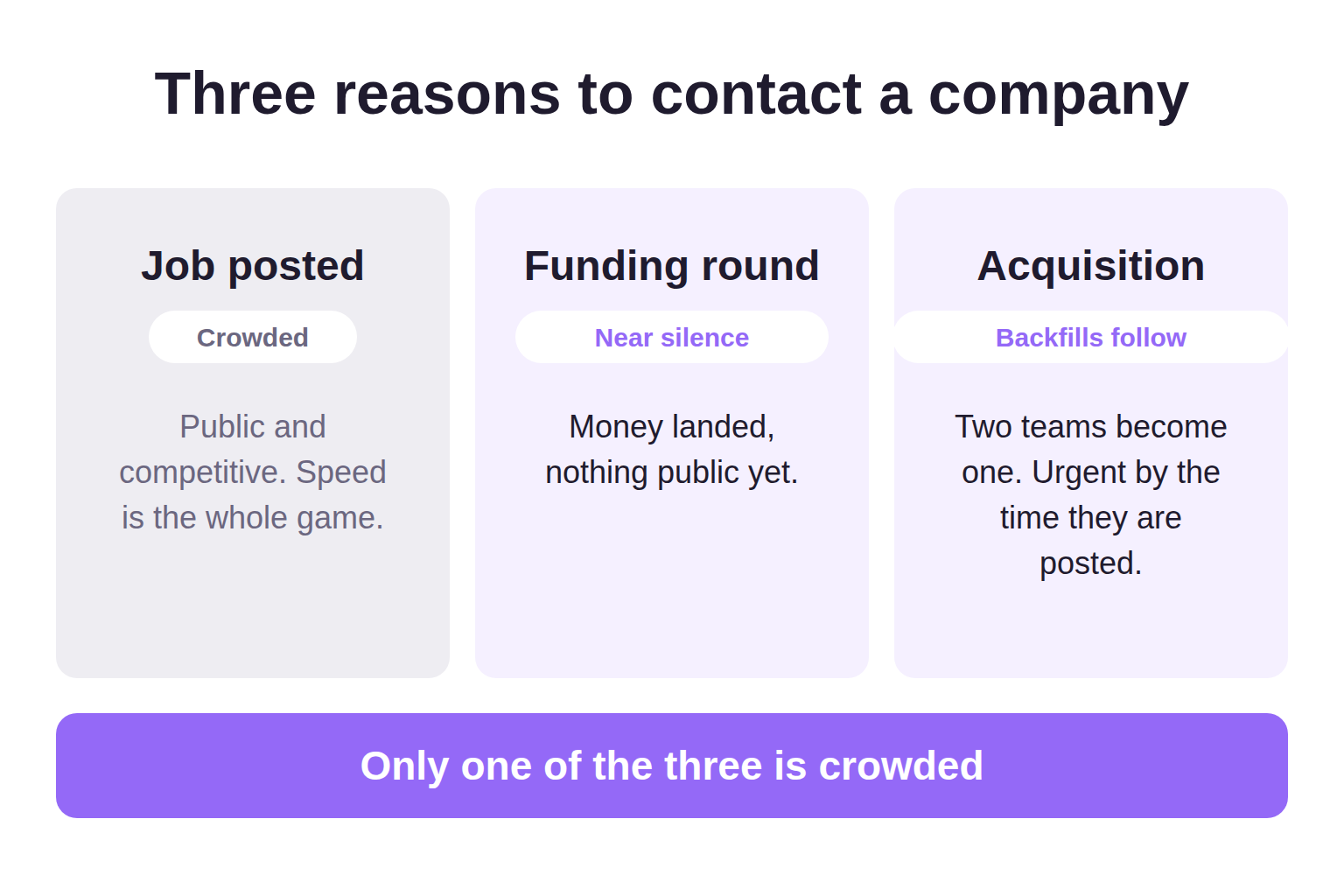
A posted role is a known need: public, competitive, and speed is the whole game. By the time it is public the decision was made weeks ago and the inbox is filling. Day one to two, the hiring manager is motivated and almost nobody has reached out. Day three to seven, the first wave lands. Week two to three, the role sits with three agencies and your email is the fourteenth. Week four, they have stopped reading.
A closed funding round is money landed and a headcount plan being written, with nothing public yet. You get a week or two of near silence while their inbox fills with congratulations rather than recruiters. A message that opens with congratulations on the round, I would guess the senior engineering hires are first on the list and hardest to fill, is not a cold email. It is someone who understands what just happened to their week.
An acquisition is two teams becoming one. Duplicate functions get reviewed. Integration roles appear that did not exist. Good people leave on their own, because the company they joined is not the company they now work for. Backfills follow quietly and are usually urgent by the time they are posted. It is the richest event in the industry and most recruiters read the announcement, assume a hiring freeze, and move on.
Same market, three completely different conversations, and only one of them is crowded.
Step four: fix the infrastructure before the copy
This is unglamorous and it decides whether anything else matters. The best-written outreach in the world has a zero percent reply rate from the spam folder.
Never send cold outreach from the domain your business runs on. One round of spam complaints and your client correspondence, candidate emails and invoices start landing in junk, and you find out when a client says they never received the contract. Buy a separate sending domain, close to your brand, and redirect it to your main site.
Warm each new inbox for roughly ten days of gradual, low-volume, reply-generating activity before it carries a campaign. There is no way to rush this and attempting to is how a new domain gets burned in its first fortnight.
Set SPF, DKIM and DMARC before the first send. Without them you are an unverified stranger and a growing number of providers will simply not deliver you.
Keep to about five inboxes per domain. Beyond that, one bad signal takes the whole domain down with it.
Work out how many inboxes you need before you start: daily prospects multiplied by sequence steps, divided by forty. Contacting thirty companies a day on a three-step sequence is ninety emails a day, which is two to three inboxes.
Watch three numbers weekly. Bounce rate above 2% means your list quality is damaging your reputation, against a platform-wide average of 5.1%. Spam complaints above 0.1% get you rejected by Gmail outright. And a reply rate falling while volume holds steady is almost always delivery rather than copy, which is the single most misdiagnosed problem in outbound.
Step five: write from evidence, not from templates
Personalisation is not their first name. It is evidence that you looked.
Generic, even when merged: I saw you are hiring a Senior Backend Engineer, we specialise in tech recruitment and have a strong network in this space.
Specific: you have had the Senior Backend Engineer role open since early August and re-posted it last week, which usually means the band is sitting ten to fifteen thousand under where the Go and Kubernetes people are actually landing, happy to send you the range we are seeing.
The second took no longer to send. It took better inputs.
A working angle has three properties. It references something observable rather than something flattering. It offers a hypothesis about their problem rather than a description of your services. And it asks for fifteen minutes rather than a partnership, because the size of the ask has to match the size of the relationship, which is currently nothing.
Keep it under 120 words, readable on a phone without scrolling. A long email implies a long commitment. A short one implies the reply will also be short, which is what makes it easy to send.
Send it to the person who owns the hire, not the careers inbox and not HR generally. They feel the vacancy daily. HR owns the process and feels it weekly. This single decision changes reply rates more than anything you do to the words.
Step six: run candidate-led campaigns too
Pitching a specific strong candidate to companies who should want them is the oldest high-conversion play in recruitment. It works because you lead with a person who solves a problem rather than asking whether they need help, and it reaches companies that are advertising nothing at all.
Nobody scales it, because reframing one candidate's background for forty different employers is a working day: three minutes to read each posting, five to work out which two things in your candidate's background answer it, five to find the right person, seven to write. Twenty minutes a company, thirteen hours for forty.
So the campaign gets cut to the ten you can manage, or it degrades into one email pasted everywhere with the company name swapped, which performs exactly like the generic outreach you were trying to escape. That is why so many recruiters believe candidate-led outreach does not work.
Get explicit written permission from the candidate before pitching them anywhere, agree what gets anonymised, and agree a time limit. A candidate pitched three months after they accepted another offer makes you look careless to every company you sent it to.
Step seven: answer replies faster than you think you need to
A hiring manager who answers your email is briefly interested, and that interest has a half-life measured in hours. They replied between meetings with a problem on their mind. By Thursday the problem has been solved by someone else or deprioritised entirely.
Sending is a volume problem. Replying is a speed problem. They need different systems, and the gap between a reply arriving and you responding is the only part of the funnel where the prospect is already interested and you are the one losing it.
The common failure is structural rather than personal: the reply lands in one of four outreach inboxes, you see it on your phone, you think you will do it properly later, and later does not arrive. Worse, the sequence you forgot to stop sends a follow-up asking whether they saw your original email.
Step eight: protect ten minutes, not four hours
Ten minutes a day beats four hours on a Friday, because it survives a bad week.
Minutes one to three, clear anything time-sensitive. Four to six, answer every reply, because replies are the most perishable asset you own. Seven to eight, move the pipeline so every open opportunity has a next action and a date. Nine to ten, review today's new leads and add the good ones to a campaign.
That last step is what decides whether ten minutes is enough. If it includes finding companies and writing from scratch, you will get through five and the habit collapses within a fortnight. If the finding and drafting already happened, ten minutes is genuinely sufficient, because your job in that window is judgement rather than production.
The shape of the first month
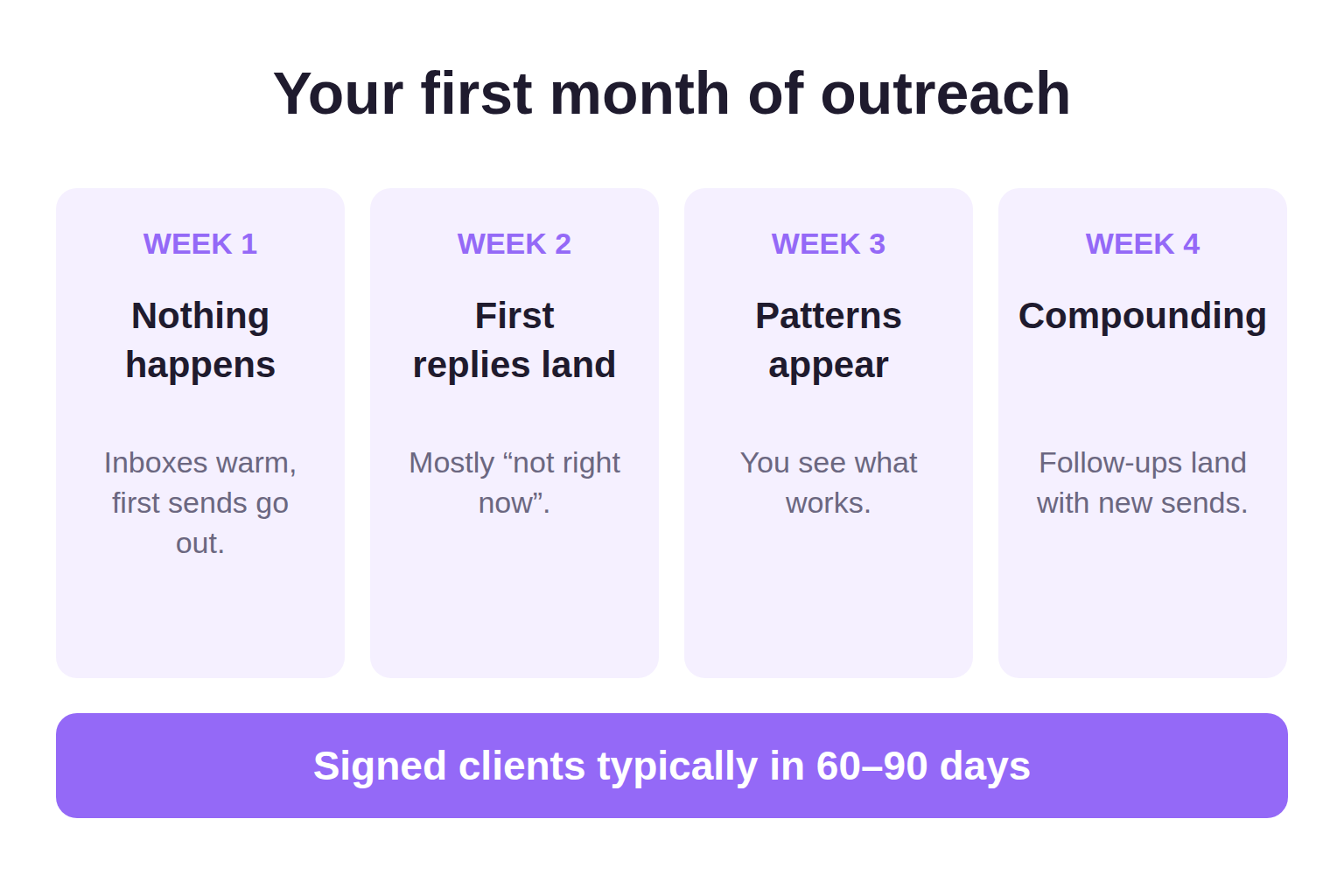
Week one, nothing happens. Inboxes warm, targeting gets tuned, first sends go out, no replies. This is the week most people quit and the week that makes the rest possible.
Week two, the first replies land. Mostly not right now. A few send me something. The temptation is to read the ratio as failure. It is not failure, it is the system reporting in, and a not right now from a company in your market means the targeting works and the timing was off.
Week three, patterns appear. Which signal converts, which message works, which company size never answers. For the first time you are deciding on evidence rather than instinct.
Week four, compounding. Follow-ups from week one land alongside new sends from week four. People who ignored you start replying, because the third touch arrives at a different moment in their month than the first did.
The recruiters getting results are not sending better messages than you. They got past day nine.
Plan for sixty to ninety days before signed clients, which is the length of the recruitment buying cycle rather than a limitation of any method. A hiring manager who replies in week two may have a problem that does not become a requisition until week seven. You are not waiting on your outreach, you are waiting on their calendar.
Frequently Asked Questions
How do recruitment agencies find clients?
Three routes: referrals from placed candidates and past clients, inbound from reputation, and outbound to companies showing a hiring signal. The third is the only one you can turn up on demand, which is why it matters most when the pipeline is thin.
How many clients does a recruitment agency need?
Fewer than most assume. At an 18,000 average fee and two to three placements per client, roughly eleven active clients supports 300,000 in billings. Run the numbers on your own fee and placement rate.
How long does recruitment business development take to work?
First replies in two to three weeks once warmup is done, real conversations in four to six, signed clients typically in sixty to ninety days. Judge nothing before day thirty.
What is the best time to do business development?
When you do not need it, which is exactly when nobody does it. The practical answer is a protected slot in the morning, every day, small enough that it survives a bad week.
Should I pull leads weekly or daily?
Daily. A role posted on Tuesday is six days cold by the following Monday, and the 24-hour window has closed on every one of them. Business development is a daily activity or it is a late one.
Start with a market and see what moved in it. Free 7-day trial at tryflynt.ai.