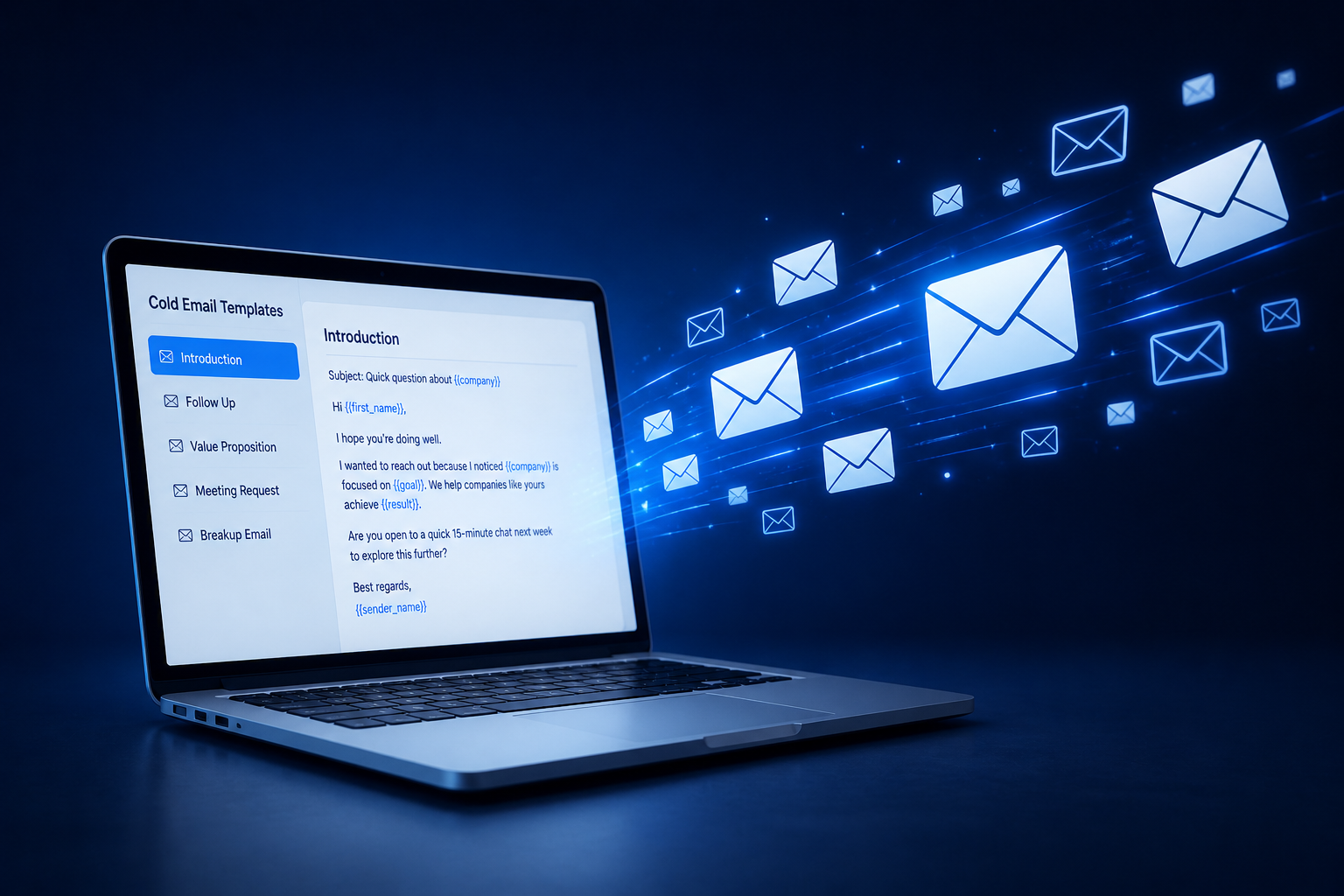
Most cold emails from recruiters get ignored — not because the recruiter is bad at recruiting, but because the email looks identical to the ninety-seven other recruiter emails in the hiring manager’s inbox that week. The subject line is generic. The opening is about the recruiter’s firm, not the reader’s situation. The ask is premature. The email has no reason to exist at this specific moment in time. This guide fixes that. What follows are eight cold email templates — each built around a specific hiring signal — with line-by-line annotations explaining why every element is there and how to personalize it for maximum response rate.
The key insight underlying all of these templates is that cold email stops being cold the moment it references something specific and timely about the recipient’s company. When your email demonstrates that you know something about their current situation — not their industry in general, not their job title, but their specific company’s specific moment — you are no longer a cold emailer. You are a well-informed peer reaching out at a relevant time. That shift in perception changes the reply rate dramatically.
Template 1: The Funding Round Trigger Email
Use when: A company in your niche has just announced a Series A or Series B funding round within the past ten business days.
Subject: [Company] Series A — congrats, quick question
Body:
Hi [Name], saw the [amount] Series A announcement this week — congratulations to you and the team. Companies at this stage typically see hiring ramp up quickly across [function relevant to your niche], and internal TA often gets stretched before the new headcount lands. I work exclusively with [niche description, e.g., ‘Series A SaaS companies building out engineering leadership’] and have placed [specific outcome, e.g., ‘VPs of Engineering and senior Staff Engineers’] at several companies at exactly this stage. Happy to share a few thoughts on what the market looks like right now if it would be useful. Worth a fifteen-minute call this week or next?
[Name]
Why it works: It is timely (references the funding event), specific (mentions your exact niche), credible (references past placements at the same stage), and the ask is small (fifteen minutes, not a full discovery call). The subject line is conversational, not salesy.
Template 2: The Executive Departure Angle
Use when: A key executive at a target company has recently announced a departure or a new executive has just joined, creating team restructuring pressure.
Subject: [Company] leadership change — a few thoughts
Body:
Hi [Name], I noticed [Executive Name] recently [joined/departed] [Company]. Leadership transitions in [function] almost always create hiring ripple effects — either rebuilding the team around a new leader’s vision or backfilling gaps left by departure. I specialize in [niche] and have helped several [role type] teams navigate exactly this kind of transition period. Not pitching — just wanted to say hello and let you know I exist in case it becomes relevant in the next ninety days.
[Name]
Why it works: It demonstrates market awareness without being presumptuous. The phrase ‘not pitching’ disarms the reader. The ninety-day framing is non-pressuring but plants the seed for a future conversation.
Template 3: The Job Posting Velocity Opener
Use when: A company has significantly increased its job posting volume in your area of specialization within the past two to three weeks.
Subject: [X] open [function] roles at [Company] — a few thoughts
Body:
Hi [Name], noticed [Company] has [X] open [function] roles posted right now — [specific role titles]. That pace of hiring almost always means internal TA is at capacity or the specialized roles are proving harder to fill than expected. I run a boutique search firm focused entirely on [niche] and have a strong pipeline of [specific candidate type] who aren’t actively looking but would consider the right opportunity. Would it make sense to connect this week?
[Name]
Why it works: The specific job count and role titles prove you looked. The insight about internal TA capacity positions you as someone who understands their situation, not someone reading from a script.
Template 4: The Geographic Expansion Play
Use when: A company has announced a new office, expansion into a new market, or geographic growth that requires local hiring.
Subject: [Company] Austin expansion — I can help
Body:
Hi [Name], saw the news about [Company] opening in [City] — exciting move. Hiring in a new market without local relationships is one of the hardest BD challenges growing companies face, especially for [function] roles where local market knowledge matters. I have [X years] in the [City] [niche] market and a deep network of [candidate type] who won’t appear on any job board. Happy to share what the market looks like there. Twenty minutes this week?
[Name]
Template 5: The Strategic Context Email
Use when: You want to reach out to a high-value target without a specific trigger event, but you have done genuine research on their business context.
Subject: [Specific observation about their business]
Body:
Hi [Name], I have been following [Company] since [specific reason — product launch, press coverage, industry mention]. Most recruiters who reach out to you are probably pitching generic services. I am going to be direct: I work exclusively with [niche], and based on what I know about your [specific business context], I think the next twelve months are going to require [specific type of talent] that is genuinely hard to find. I am not asking for a commitment — just a thirty-minute conversation to share what I am seeing in the market. If it is not relevant, no harm done.
[Name]
Follow-Up Sequence: The Three-Touch System
Most cold email response rates improve significantly with structured follow-up. Here is the recommended sequence:
Touch 1 is your initial email (templates above) sent on a Tuesday, Wednesday, or Thursday.
Touch 2 is a brief follow-up five to seven business days later — do not resend the original email, add a new piece of context or value (‘One thing I forgot to mention in my last note…’)
Touch 3 is a ‘final reach-out’ fourteen days after Touch 1 — explicitly state it is your last email, include a low-commitment offer (‘If now isn’t the right time, totally understand — happy to reconnect whenever the timing is better’).
Response rates for cold email in recruiting BD in 2026 average between two and eight percent for generic outreach. Signal-based outreach using the templates above — with genuine personalization — consistently produces response rates between eight and twenty percent. The difference is relevance and timing, not volume.
Frequently Asked Questions
Q: What is the best cold email subject line for recruiting business development?
The highest-performing subject lines for recruiter BD emails in 2026 are specific and conversational rather than formal or salesy. Reference the company name and a specific context (‘Acme Series A — quick question’) rather than generic openers (‘Recruiting services introduction’). Keep subject lines under fifty characters for mobile readability.
Q: How many follow-up emails should I send before giving up?
Three touches over twenty-one days is the optimal sequence for most recruiting BD outreach. The first touch generates the highest response rate, the second touch catches people who saw the first but didn’t reply, and the third touch provides a clear close. Beyond three touches without a response, you are diminishing returns and risking being marked as spam.
Q: What should I never do in a recruiting BD cold email?
Never open with a paragraph about your firm or your services. Never use ‘I hope this email finds you well.’ Never make the primary ask a sales call rather than a conversation. Never send the same email to multiple people at the same company. And never follow up more than once in the first week — spacing your follow-up appropriately signals that you are a professional, not a desperate vendor.
Ready to Put This Into Practice?
The intelligence that makes these templates convert — hiring signal data, company context, decision-maker mapping — is what Flynt delivers automatically. Stop spending mornings on research. Let Flynt surface the signal, and focus your time on the outreach that wins clients. Try Flynt free at flynt.ai.