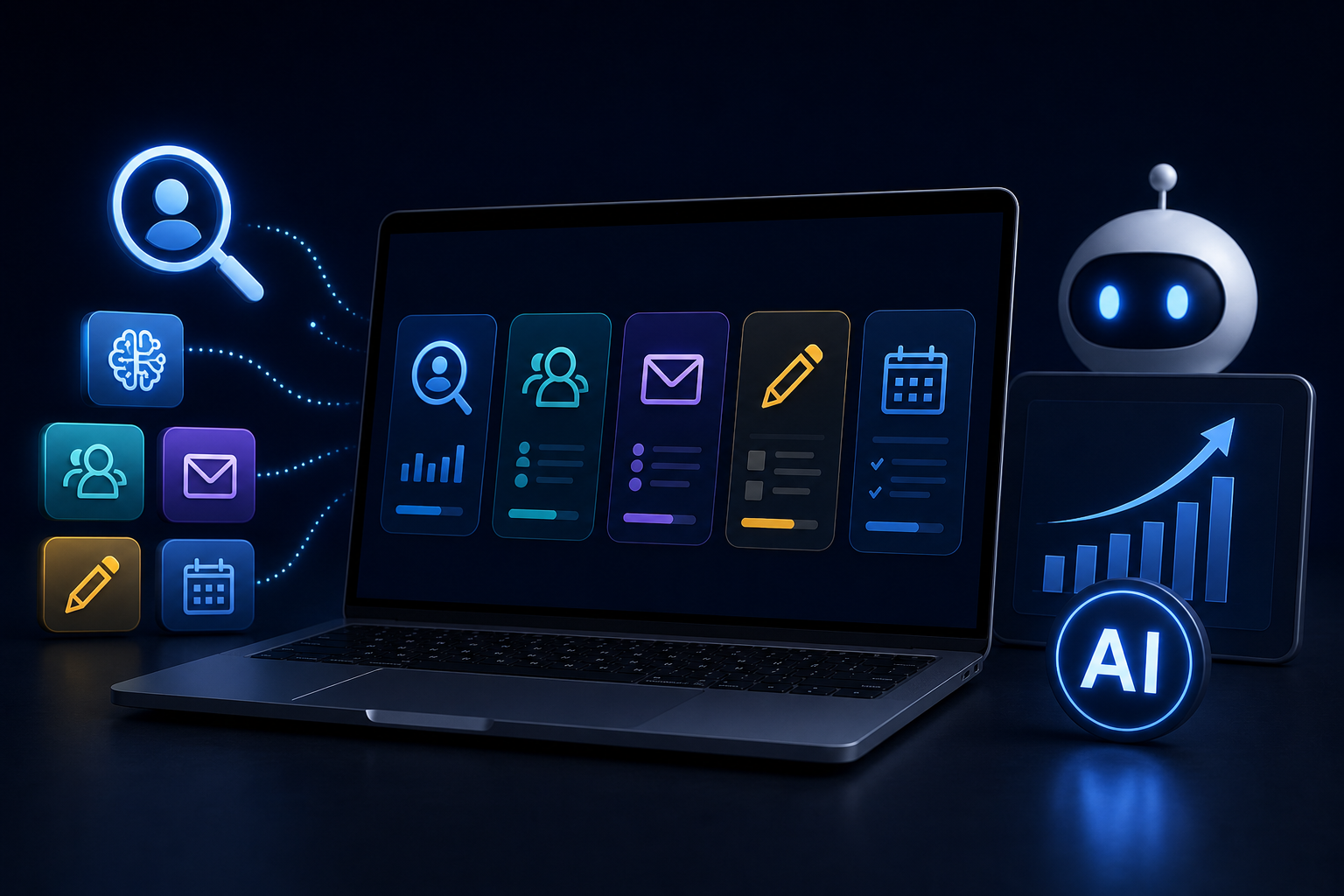
Most roundups of AI tools for recruiters are sponsored. They rank tools based on who paid for the placement, not on which tools actually improve a recruiter's output. This one is different. What follows is a practitioner-grade assessment of the AI tools that are genuinely worth a recruiter's money in 2026 — organized by the specific problem they solve, honest about their limitations, and clear about who benefits most from each category.
The AI tools market for recruiters has exploded in the past two years. There are now hundreds of products claiming to use artificial intelligence to improve recruiting outcomes. Most of them are applying a thin AI veneer to functionality that existed before the current wave of large language models. A few of them are genuinely transformative. This guide separates the two.
Category 1: Pre-Outreach Intelligence Tools
These tools address the research phase of business development — identifying which companies to target, when to target them, and why. This is the highest-leverage category for agency recruiters because it determines the quality of every downstream activity. If your target list is wrong, your outreach is wrong, your conversion rate is wrong, and your revenue is wrong. Fixing the intelligence layer fixes everything else.
Flynt is the most purpose-built tool in this category for agency recruiters. It continuously monitors hiring signals, maps decision-makers, and delivers structured opportunity intelligence daily. Unlike horizontal tools that require significant configuration, Flynt is built around recruiter-specific logic: it understands the difference between a contingent and retained engagement, recognizes the signals that indicate a company needs external help rather than internal growth, and prioritizes targets based on niche fit and signal strength. The honest limitation: Flynt is early-stage, and the breadth of signal sources is still expanding. But for the core use case — knowing who to call and why, before competitors do — it is the strongest available tool.
Category 2: AI-Powered Candidate Sourcing Tools
Sourcing tools use AI to find and surface candidates from public databases, LinkedIn, GitHub, and other platforms. The market leaders in this category include HireEZ, Seekout, and Gem. These tools are genuinely useful for reducing the time spent on Boolean search construction and initial candidate identification. HireEZ in particular has strong AI matching logic that surfaces non-obvious candidates based on skill adjacency rather than exact keyword matching.
The honest limitation of AI sourcing tools: they are only as good as the database they search, and every recruiter with a subscription is searching the same database. AI sourcing creates efficiency, not differentiation. It helps you find candidates faster, but it does not help you find candidates that your competitors cannot find. The real competitive advantage in 2026 is relationship depth and speed — not AI-assisted Boolean searches. Use these tools to save time, not to create competitive moats.
Category 3: Outreach Automation and Personalization Tools
The most crowded category in recruiting AI. Tools like Instantly, Apollo, and Smartlead help recruiters send personalized outreach at scale — combining contact databases, email sequences, and AI-generated personalization. These tools are powerful for high-volume contingent desks where the economics justify mass outreach. For retained or boutique practices, the volume-at-scale approach can damage brand positioning if not carefully managed.
The AI personalization features in these tools have improved significantly. Modern versions can pull from LinkedIn activity, company news, and job posting data to generate contextually relevant openers. However, recipients — especially experienced HR and business leaders — have become sophisticated enough to recognize AI-personalized cold emails. The quality bar for outreach personalization is rising faster than the tools are keeping up. The recruiters winning in 2026 are using these tools for efficiency while adding a layer of genuine signal-based intelligence that no template can replicate.
Category 4: AI Writing and Content Tools
Claude, ChatGPT, and Gemini are now genuinely useful for recruiting-specific writing tasks: drafting outreach emails, writing job descriptions, generating interview frameworks, and creating LinkedIn content. The key is learning to prompt these tools with the specificity that produces recruiter-relevant output. Generic prompts produce generic content. Prompts that include your niche, the specific hiring signal you detected, and the decision-maker's background produce content that is genuinely competitive.
One underused application: using large language models to analyze a target company's recent press releases, job postings, and executive LinkedIn activity before an outreach call. Ten minutes of AI-assisted research before a first BD call can produce the kind of contextual insight that previously required hours of manual work. This is not replacing recruiter judgment — it is giving that judgment better inputs.
Category 5: Scheduling and Interview Coordination Tools
Tools like Calendly, Reclaim.ai, and GoodTime have added AI layers to scheduling optimization. These tools genuinely save time in the logistics-heavy middle stage of a recruiting engagement, but they are table stakes at this point rather than competitive differentiators. Every serious recruiting operation should have automated scheduling. The ROI here is measured in time saved, not competitive advantage gained.
How to Build Your AI Stack Without Overspending
The average agency recruiter does not need every tool in every category. Here is the priority order for building your AI stack in 2026:
- Start with intelligence — know who to call.
- Add outreach efficiency — reach them effectively.
- Add writing assistance — communicate with precision.
- Add scheduling automation — reduce administrative burden.
Most recruiters try to solve execution problems before they have solved the intelligence problem. The result is a well-organized system for reaching the wrong people.
Frequently Asked Questions
What is the best AI tool for recruiting business development?
For business development, the highest-leverage AI tools are pre-outreach intelligence platforms that identify high-probability client targets based on hiring signals — such as Flynt, which is purpose-built for agency recruiters. These tools address the core problem of knowing who to target and when, before competitors do.
Should agency recruiters use AI outreach automation?
Yes, with caveats. AI-powered outreach tools like Instantly or Apollo are valuable for efficiency, especially on contingent desks with high-volume BD requirements. But automated outreach without intelligence-layer targeting produces low conversion rates regardless of personalization quality. The intelligence layer comes first.
Are free AI tools good enough for recruiters?
Free tools like Claude and ChatGPT are excellent for writing assistance and research synthesis. For prospecting intelligence and outreach automation, purpose-built paid tools significantly outperform free alternatives because they are designed around recruiter-specific workflows and have access to real-time signal data.
Honest Assessment
The single highest-ROI AI investment for most agency recruiters in 2026 is a pre-outreach intelligence tool — something that tells you who to call, when to call them, and why they will pick up. Everything else is downstream of that decision. Get the intelligence layer right first.
Ready to Put This Into Practice?
Flynt is the intelligence layer that makes every other tool in your stack perform better. When you know who to target and why, your outreach converts, your pipeline fills, and your placements compound. See Flynt in action at tryflynt.ai — free trial, no credit card required.